
A cross platform, customizable graphical frontend for launching emulators and managing your game collection.
A cross platform, customizable graphical frontend for launching emulators and managing your game collection.



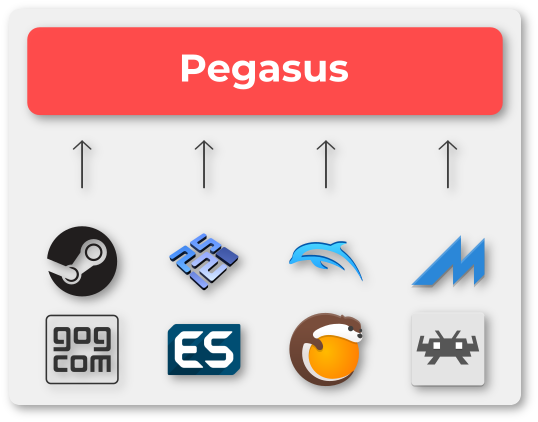
Pegasus is a graphical frontend for browsing your game library (especially retro games) and launching them from one place. It's focusing on customizability, cross platform support (including embedded devices) and high performance.
Instead of launching different games with different emulators one by one manually, you can add them to Pegasus and launch the games from a friendly graphical screen from your couch. You can add all kinds of artworks, metadata or video previews for each game to make it look even better!
With additional themes, you can completely change everything that is on the screen. Add or remove UI elements, menu screens, whatever. Want to make it look like Kodi? Steam? Any other launcher? No problem. You can add animations and effects, 3D scenes, or even run your custom shader code.
Pegasus can run on Linux, Windows, Mac, Raspberry Pi, Odroid and Android devices. It's compatible with EmulationStation metadata and gamelist files, and instantly recognizes your Steam games!
log_message "Script completed" By following these shell deployment standards, you can ensure that your shell scripts are written, deployed, and maintained in a consistent, reliable, and secure manner.
# Your code here
Shell deployment standards are a set of best practices and guidelines for deploying and managing shell scripts, commands, and other executable code in a Linux or Unix-like environment. The goal of these standards is to ensure that shell code is written, deployed, and maintained in a consistent, reliable, and secure manner. shell dep standards
# Functions log_message() { echo "$(date) - $1" >> "$LOG_FILE" }
# Script header # ================================================================================ # script_name: example.sh # Description: An example shell script # Author: Your Name <your@email.com> # Date: 2023-02-20 # Version: 1.0 # ================================================================================ # Functions log_message() { echo "$(date) - $1"
#!/bin/bash
# Main script body set -e set -x
# Variables and constants SCRIPT_DIR=$(dirname "$0") LOG_FILE="${SCRIPT_DIR}/example.log"
log_message "Script started"


