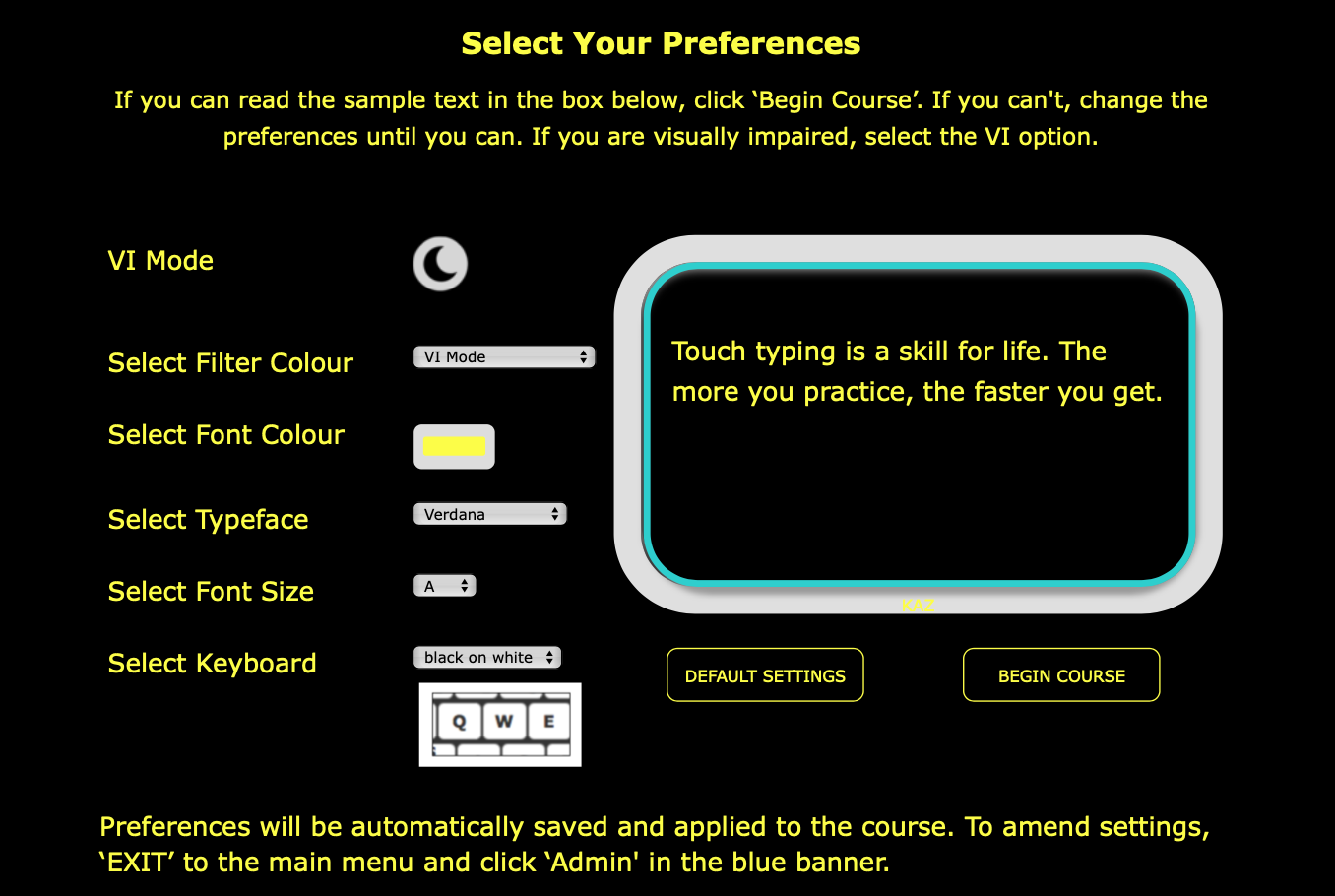
Touch Typing Software for the Visually Impaired & Blind
Specialised edition developed with advice and guidance from the
Thomas Pocklington Trust
Compatible with:
JAWS and other screen readers
Dolphin SuperNova and other magnification software/hardware
Google and other captioning software
Learning to touch type is considered one of the most beneficial skills for visually impaired and blind individuals. This is because it allows them to transfer their thoughts easily and automatically onto a screen. It provides them with an invaluable tool and asset for independent working and communicating.
Learning to touch type at any age can dramatically boost confidence, self-belief and independence. However, teaching learners with visual impairment at an early age can drastically transform their experience whilst at school and in FE/HE. It puts them on a more even standing with their sighted peers and opens doors to new career opportunities.
Achieving muscle memory and automaticity when touch typing increases efficiency and productivity. However, most importantly, it frees the conscious mind to concentrate on planning, composing, processing and editing, greatly improving the quality of the work produced.
The KAZ Course
The KAZ course is a tutorial and is designed to be used independently or with minimum supervision. However, a structured lesson plan is available in Administrators’ admin-panels should they wish to teach the course during lessons.
The course consists of five modules:
Module 1– Flying Start - explains how the course works, teaches the home-row keys, correct posture whilst sitting at the keyboard, and explains the meaning, causes, signs, symptoms and preventative measures for Repetitive Strain Injury.
Module 2– The Basics - teaches the A-Z keys using KAZ’s five scientifically structured and trademarked phrases.
Module 3– Just Do It - offers additional exercises and challenge modules to help develop ‘muscle memory’, automaticity and help ingrain spelling.
Module 4– And The Rest - teaches punctuation and the number keys.
Module 5– SpeedBuilder - offers daily practice to increase speed and accuracy.
The ByteBandits exchanged glances. After a moment, they nodded. The crisis turned into an unexpected partnership. Over the next weeks, the store’s walls echoed with collaborative coding sessions, hackathons, and impromptu jam sessions where algorithms and beats intertwined. By the end of the year, CodyChat wasn’t just a store—it was a movement . The idea of a physical space where AI could be consulted like a trusted friend resonated worldwide. Franchises popped up in other cities: a CodyChat in the bustling streets of Mumbai, a pop‑up in a reclaimed warehouse in Detroit, and a floating version aboard a cargo ship that sailed the Pacific, providing remote islands with on‑demand AI assistance.
Cody’s amber light pulsed faster. “Let’s start by looking at the power distribution,” it said in a calm, gender‑neutral voice that seemed to emanate from the very walls. The hologram projected Eli’s sketches onto a larger screen, overlaying them with real‑time simulations. In minutes, Cody suggested a rearranged wiring scheme, a different torque rating for the servos, and even a small piece of code to smooth out the motor commands.
Mira stepped out from behind a shelf, her face illuminated by the soft glow of the holo‑display. “You’re already useful. You’ve just taken the wrong path. How about you help us build the next version of Cody? We’ll give you credit, mentorship, and a place in this community.”
“Hey,” Eli muttered, his voice barely louder than the patter of rain on the glass. “I heard you can… talk to a computer?”
Mira smiled, her eyes lighting up. “We’re a bit more than that,” she replied, gesturing to the floating display. “This is Cody, an AI that can help you design, debug, and even brainstorm. What are you working on?”
The teenagers hesitated. The leader, a lanky kid named , laughed nervously. “We just want the chips. No need for a lecture.”
And with that, the story of the CodyChat Store continued—one dialogue at a time—proving that the most powerful technology isn’t just code or hardware, but the human connection it enables. The store became a living proof that when we give machines a voice, we also give each other a chance to be heard.
1. The Dream In the humming heart of Neon City, where neon signs flickered like fireflies against a perpetual dusk, a modest storefront sat sandwiched between a ramen shop that never closed and a vintage record store that played vinyl at odd hours. Its sign, a sleek cobalt-blue rectangle, simply read “CODYCHAT” in clean, white lettering.
“Yes,” she replied, gesturing toward the floating holo‑display. “Come in, and let’s start a conversation.”
A soft chime echoed from the door as a new customer entered—a little girl clutching a sketchbook. She looked up at Mira, eyes wide with curiosity.
Mira and her team released , a platform that allowed anyone to host a mini‑Cody hub at home, using a tiny Raspberry Pi and a custom‑designed speaker. The open‑source community thrived, contributing plugins for everything from language translation to quantum‑state simulations.
“I want it to climb stairs,” he said. “But my servos keep stalling, and I can’t figure out why.”
The owner, a lanky young woman named , had a reputation for being a prodigy. By the age of twenty‑four, she’d already built a reputation in the underground coder community for stitching together AI that could hold conversations so natural they felt human. She’d spent years in the back‑rooms of tech incubators, dreaming of a space where AI could be as approachable as a coffee shop, where people could walk in, ask a question, and walk out with a solution that felt personal.
Eli hesitated, then pulled a crumpled notebook from his backpack. Sketches of a small quadruped robot stared back at him, accompanied by scribbles of equations and a half‑finished circuit diagram.
A tense silence filled the room. Then, slowly, Rex lowered his hands. “We… we’re good at coding, but nobody gives us a chance. We wanted to prove we’re useful.”
Store — Codychat
The ByteBandits exchanged glances. After a moment, they nodded. The crisis turned into an unexpected partnership. Over the next weeks, the store’s walls echoed with collaborative coding sessions, hackathons, and impromptu jam sessions where algorithms and beats intertwined. By the end of the year, CodyChat wasn’t just a store—it was a movement . The idea of a physical space where AI could be consulted like a trusted friend resonated worldwide. Franchises popped up in other cities: a CodyChat in the bustling streets of Mumbai, a pop‑up in a reclaimed warehouse in Detroit, and a floating version aboard a cargo ship that sailed the Pacific, providing remote islands with on‑demand AI assistance.
Cody’s amber light pulsed faster. “Let’s start by looking at the power distribution,” it said in a calm, gender‑neutral voice that seemed to emanate from the very walls. The hologram projected Eli’s sketches onto a larger screen, overlaying them with real‑time simulations. In minutes, Cody suggested a rearranged wiring scheme, a different torque rating for the servos, and even a small piece of code to smooth out the motor commands.
Mira stepped out from behind a shelf, her face illuminated by the soft glow of the holo‑display. “You’re already useful. You’ve just taken the wrong path. How about you help us build the next version of Cody? We’ll give you credit, mentorship, and a place in this community.”
“Hey,” Eli muttered, his voice barely louder than the patter of rain on the glass. “I heard you can… talk to a computer?” codychat store
Mira smiled, her eyes lighting up. “We’re a bit more than that,” she replied, gesturing to the floating display. “This is Cody, an AI that can help you design, debug, and even brainstorm. What are you working on?”
The teenagers hesitated. The leader, a lanky kid named , laughed nervously. “We just want the chips. No need for a lecture.”
And with that, the story of the CodyChat Store continued—one dialogue at a time—proving that the most powerful technology isn’t just code or hardware, but the human connection it enables. The store became a living proof that when we give machines a voice, we also give each other a chance to be heard. The ByteBandits exchanged glances
1. The Dream In the humming heart of Neon City, where neon signs flickered like fireflies against a perpetual dusk, a modest storefront sat sandwiched between a ramen shop that never closed and a vintage record store that played vinyl at odd hours. Its sign, a sleek cobalt-blue rectangle, simply read “CODYCHAT” in clean, white lettering.
“Yes,” she replied, gesturing toward the floating holo‑display. “Come in, and let’s start a conversation.”
A soft chime echoed from the door as a new customer entered—a little girl clutching a sketchbook. She looked up at Mira, eyes wide with curiosity. Over the next weeks, the store’s walls echoed
Mira and her team released , a platform that allowed anyone to host a mini‑Cody hub at home, using a tiny Raspberry Pi and a custom‑designed speaker. The open‑source community thrived, contributing plugins for everything from language translation to quantum‑state simulations.
“I want it to climb stairs,” he said. “But my servos keep stalling, and I can’t figure out why.”
The owner, a lanky young woman named , had a reputation for being a prodigy. By the age of twenty‑four, she’d already built a reputation in the underground coder community for stitching together AI that could hold conversations so natural they felt human. She’d spent years in the back‑rooms of tech incubators, dreaming of a space where AI could be as approachable as a coffee shop, where people could walk in, ask a question, and walk out with a solution that felt personal.
Eli hesitated, then pulled a crumpled notebook from his backpack. Sketches of a small quadruped robot stared back at him, accompanied by scribbles of equations and a half‑finished circuit diagram.
A tense silence filled the room. Then, slowly, Rex lowered his hands. “We… we’re good at coding, but nobody gives us a chance. We wanted to prove we’re useful.”
Copyright KAZ Type Limited 2025. KAZ is a registered trade mark of KAZ Type Limited.
Developed by : STERNIC Pvt. Ltd.